
 Admin
Admin When I first started searching for rustic recipes without a dutch oven or heavy pot, I felt like every single blog assumed I owned a Le Creuset and a farmhouse kitchen. I didn’t. I had a beat-up sheet pan, a basic skillet, and a stubbornness that refused to let me eat boring food. Turns out, you can make deeply satisfying, soul-warming meals without any of that heavy equipment. I’ve been doing it for years now, and honestly, I prefer it.
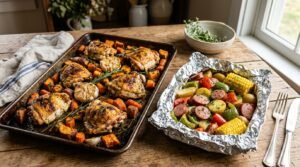
1. Sheet Pan Chicken Thighs with Root Vegetables
This is where it all started for me. Bone-in chicken thighs, tossed on a sheet pan with cubed sweet potatoes, carrots, and a few whole garlic cloves. A drizzle of olive oil, salt, pepper, and a generous shake of smoked paprika. That’s it.
The oven does all the work at 425°F for about 40 minutes. The chicken skin gets impossibly crispy while the vegetables caramelize underneath, soaking up all those rendered juices. I make this at least twice a month, and it never gets old. The trick is cutting your vegetables roughly the same size so everything finishes together. Don’t overthink it.
2. Skillet Braised White Beans with Sausage
People act like you need a heavy enameled pot to braise anything. You don’t. A regular 12-inch skillet with a lid works perfectly fine for a shallow braise, and white beans practically beg for this treatment.
Brown some Italian sausage (I like the hot variety from my local butcher) in the skillet, then add a diced onion and a few crushed garlic cloves. Pour in two cans of cannellini beans with their liquid, a cup of chicken broth, and a handful of torn kale. Cover it, drop the heat to low, and let everything meld for about 25 minutes. A squeeze of lemon at the end makes it sing. This is one of those rustic recipes without a dutch oven or heavy pot that tastes like it simmered for hours.
3. Campfire-Style Foil Packet Dinners
I grew up eating these on camping trips, but they work just as well in a regular oven. You take a big sheet of heavy-duty aluminum foil, pile on some protein and vegetables, season it, fold the foil into a sealed packet, and bake at 400°F for about 30 minutes.
My go-to combination is sliced kielbasa with baby potatoes, bell peppers, and corn. I hit it with Cajun seasoning and a tablespoon of butter before sealing. The steam trapped inside basically pressure-cooks everything, and you get this concentrated, smoky flavor without any special gear. Plus, cleanup is almost nonexistent. Just crumple the foil and toss it.
4. Baking Dish Ratatouille
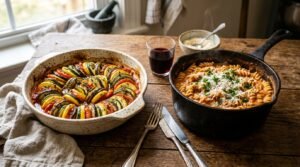
Ratatouille looks fancy, but it’s really just a peasant dish at heart. And you absolutely do not need a dutch oven for it. A standard 9×13 ceramic or glass baking dish handles it beautifully.
Slice your zucchini, yellow squash, eggplant, and tomatoes into thin rounds. Spread a quick sauce on the bottom of the dish (crushed tomatoes, garlic, olive oil, salt), then shingle the vegetable slices on top in alternating rows. Drizzle more olive oil, cover tightly with foil, and bake at 375°F for about 45 minutes. Remove the foil for the last 15 minutes to get some color. Fresh basil and a crumble of goat cheese on top, and you’ve got something that looks restaurant-worthy but came out of the simplest pan you own.
5. One-Pot Pasta in a Regular Saucepan
Before you say “that’s not rustic,” hear me out. Tossing pasta, broth, tomatoes, and aromatics into a single saucepan and cooking it all together is exactly the kind of resourceful, waste-nothing cooking that defines rustic food.
I use a basic 4-quart saucepan for this. Add penne or rigatoni, a can of diced fire-roasted tomatoes, three cups of chicken stock, a sliced onion, four smashed garlic cloves, and a big pinch of red pepper flakes. Bring everything to a boil, then reduce to a steady simmer and stir frequently for about 12 minutes. The pasta releases its starch directly into the liquid, creating a silky sauce without any cream. Finish with grated Parmesan and fresh parsley. It costs almost nothing and takes under 20 minutes.
6. Slow Cooker Beef Stew (No Heavy Pot Required)
I know, stew screams dutch oven. But a basic slow cooker handles beef stew with zero complaints, and honestly, I think it does a better job because you can set it and forget it for eight hours while you live your life.
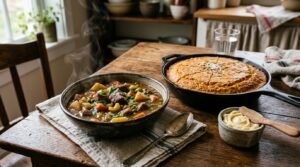
Cut chuck roast into chunks, season with salt and pepper, and give them a quick sear in your skillet. Transfer everything to the slow cooker with diced potatoes, carrots, celery, a can of tomato paste, beef broth, and a bay leaf. Set it on low. When you come back, the meat falls apart with a fork and the broth is thick and rich. I toss in frozen peas during the last 30 minutes for color and sweetness. This is proof that rustic recipes without a dutch oven or heavy pot can still deliver that deep, long-cooked comfort.
7. Cast Iron Skillet Cornbread
You might wonder why cast iron skillet is fine but a cast iron dutch oven isn’t. Fair question. The answer is weight and accessibility. Most people already own a 10-inch cast iron skillet, and it weighs about five pounds. A dutch oven weighs 12 to 15. Big difference when you’re pulling it out of a hot oven.
Preheat your skillet in the oven at 425°F with a tablespoon of butter melting inside. While it heats, mix together one cup of cornmeal, one cup of flour, a tablespoon of sugar, a tablespoon of baking powder, one egg, a cup of buttermilk, and a quarter cup of melted butter. Pour the batter into the screaming-hot skillet and bake for 20 to 22 minutes. The bottom gets a golden, crunchy crust that you simply cannot replicate in a regular pan. Serve it with honey butter and your stew from the slow cooker. Perfect pairing.
8. Oven-Roasted Bone Broth on a Sheet Pan
This one surprises people. You can absolutely start a bone broth without a stockpot. Roast beef or chicken bones on a sheet pan at 450°F for about 30 minutes until they’re deeply browned. Then transfer everything, bones, caramelized bits, all of it, into whatever pot you have. Even a regular saucepan works if you’re making a smaller batch.
Cover with water, add a splash of apple cider vinegar, an onion cut in half, and a few peppercorns. Simmer on the lowest setting your stove has for as long as you can manage. Four hours minimum, overnight if you’re feeling ambitious. The sheet pan roasting step is what gives the broth that dark, rich color and intense flavor that most home cooks struggle to achieve. Strain it through a fine mesh sieve and you’ve got liquid gold for soups, grains, and sauces all week long.
9. Grilled Flatbread on a Regular Grill or Grill Pan
Rustic bread doesn’t require a covered pot or a brick oven. A simple flatbread dough, grilled on your backyard grill or an indoor grill pan, gives you that charred, bubbly, slightly smoky bread that pairs with literally everything.
Mix two cups of flour, one teaspoon of salt, one teaspoon of baking powder, three-quarters cup of Greek yogurt, and a tablespoon of olive oil. Knead for two minutes. Divide into four balls, roll them out thin, and throw them onto a hot, lightly oiled grill. Two minutes per side. That’s all. You get beautiful char marks and a soft, chewy interior. Top them with garlic butter and fresh herbs, or use them to scoop up stew, beans, or roasted vegetables. I started making these during a summer when my oven broke, and now I prefer them to any store-bought bread.
10. Skillet Berry Cobbler
Dessert deserves a spot here because rustic cooking is incomplete without something sweet bubbling away in a pan. A berry cobbler in a 10-inch skillet is one of the easiest desserts I’ve ever made, and it looks like you spent hours on it.
Toss four cups of mixed berries (I use a frozen blend from Costco, no shame) with a quarter cup of sugar and a tablespoon of cornstarch directly in the skillet. For the topping, mix one cup of flour, a third cup of sugar, a teaspoon of baking powder, a pinch of salt, six tablespoons of cold cubed butter, and a quarter cup of milk. Drop spoonfuls of the dough over the berries in a rough, imperfect pattern. Bake at 375°F for 35 to 40 minutes until the top is golden and the fruit is bubbling up around the edges. Serve it warm with vanilla ice cream. Nobody will ask what kind of pot you used.

FAQs
Can you really braise meat without a dutch oven?
Absolutely. A regular skillet with a tight-fitting lid, a slow cooker, or even a deep baking dish covered with foil all work for braising. The key is maintaining low, steady heat and keeping moisture trapped inside. I’ve braised short ribs in a covered casserole dish at 300°F for three hours, and they turned out fork-tender every time.
What makes a recipe “rustic” exactly?
Rustic cooking is about simplicity, using basic ingredients and straightforward techniques without fussing over perfection. Think rough-cut vegetables, hearty portions, and recipes that don’t require precision or expensive equipment. It’s the kind of food that feeds a family without pretension. Looks imperfect, tastes incredible.
Are rustic recipes without a dutch oven or heavy pot just as flavorful?
They really are. Flavor comes from proper seasoning, browning, and cooking time, not from the vessel. A sheet pan at high heat creates the same Maillard reaction as a dutch oven. A slow cooker builds the same depth over hours. The pot matters way less than people think. Good technique wins every time.
What’s the best substitute for a dutch oven?
It depends on what you’re making. For stews and braises, a slow cooker is the easiest swap. For bread and roasting, a baking dish with a foil cover works great. For stovetop simmering, any heavy-bottomed saucepan with a lid handles the job. I’ve used all three interchangeably for years with great results.
Do I need cast iron to cook rustic food?
Not at all. Cast iron is nice to have, but a basic nonstick skillet, a stainless steel pan, or even a well-seasoned carbon steel pan all get the job done. Rustic cooking existed long before fancy cookware marketing. Use what you have and focus on the food itself.
Conclusion
Cooking hearty, rustic food has never required expensive or heavy equipment. If you’ve got a sheet pan, a skillet, and a little patience, you can make meals that feel like they came out of a countryside kitchen. So what’s the first recipe you’re going to try?